
real estate

No bust no boom just rebalancing No bust, no boom, just rebalancing

No bust, no boom, just rebalancing

The US housing market in 2026 isn’t set for a dramatic crash or an explosive boom. Instead, expect a period of modest growth and gradual rebalancing. Picture it less like a roller coaster and more like a steady climb, with a few bumps along the way. This is welcome news for those who’ve been waiting on the sidelines, uncertain about the market’s direction. Real estate market predictions for 2026: no bust, no boom, just rebalancing As we approach the year 2026, I’ve been looking at all the reports and talking to people who live and breathe real estate. It seems that the feverish rhythm of a few years ago has definitely calmed down. We’re not seeing the crazy bidding wars or houses going off the market in one day like we saw during the pandemic. On the other hand, fears of a massive price drop also seem exaggerated. Here’s my opinion, based on what the experts say and what I’ve seen myself: the market is returning to a more normal pace. Prices will likely slowly rise, and more homes will be sold, but it won’t be a story of explosive profits or devastating losses. What’s causing this predictable path? What makes me confident that things will stay relatively stable is a mix of economic factors, housing availability, and, of course, the cost of borrowing money. Interest Rates: Still a Big Problem, But Improving   The days of snagging an almost free mortgage are long gone, and it’s unlikely they’ll return anytime soon. Experts predict the average 30-year fixed mortgage rate will hover around 6.3% in 2026. That’s a bit lower than before, which is worth noting, but still much higher than the rock-bottom rates from a few years back. This steeper borrowing cost is a big reason we won’t see a housing boom—it makes buying a home pricier and slows price growth. I remember when mortgages felt like free money. Now, the jump in monthly payments is something everyone has to consider, and it can quickly become a major hurdle for many buyers. More houses are hitting the market, though it’s not exactly a flood. One of the biggest challenges for buyers in recent years has been the limited selection, but that’s starting to change. For 2026, the supply of homes for sale is expected to rise to about 4.6 months, a healthier figure compared to the 3 or 4 months we’ve seen lately. In other words, if no new homes were added, it would take roughly 4.6 months to sell what’s currently available. With more options out there, sellers may need to be a bit more patient and open to negotiating. This boost in supply is a key reason why sales could climb to around 4.2 million homes. The economy: The overall health of the economy plays a big role. By 2026, we expect steady growth, with the Gross Domestic Product (GDP) projected to rise between 2% and 2.25%. The unemployment rate should hover around 4.7%, which isn’t bad at all. Inflation, though still something to watch, is likely to settle between 2.3% and 3%. Altogether, these numbers suggest an economy that’s neither overheating nor collapsing, creating a stable backdrop for the housing market without sudden price spikes or crashes. A look at the numbers: what the experts say To give you a clearer picture, let’s look at some of the key predictions. Factor Current (estimate end of 2025) Projected (2026) Key takeaway Housing price change Slight drop/plateau +1% to +2.2% Modest and controlled growth, not a boom. Home sales volume ~4.08 million 4.13-4.26 million Gradual increase, but still below the pre-pandemic level. 30-year mortgage rate ~6.6% – 6.7% ~6.3% It remains high, which affects affordability. Inventory (Months) 3-4 months ~4.6 months Improved offer, relieving buyer pressure. GDP growth – 2% – 2.25% Constant economic expansion. Unemployment rate – ~4.7% Healthy labor market. Inflation – 2.3% – 3% Cooling down, but still a factor. The numbers clearly tell a story of moderation. We’re not heading into a steep price drop like the 2006-2008 crash, nor are we seeing the double-digit percentage jumps of 2020-2022.  Regional differences: it is not the same everywhere! One key thing to remember is that the American housing market isn’t one big, uniform entity—location plays a huge role.     Cooling in the Sun Belt: States like Florida and Texas, which experienced massive growth, could start to cool off a bit. Factors like rising insurance costs (especially in Florida) and potential overbuilding in some areas might lead to slightly lower prices or slower growth.     Rust Belt Rising (Slowly): Meanwhile, Rust Belt cities, such as Cleveland and parts of the Midwest, may see steadier, more reliable gains. Why? Because they’re more affordable, and more people are moving there in search of jobs and a lower cost of living.     Let’s put this into a table so it’s super clear: Region/Metro Projected price change (2026) Key driver Cleveland, Ohio, USA +3% to +4% Affordability, job stability Chicago, Illinois +2.5% Shortage of supply and urban reactivation Miami, Florida -2% to -3% Insurance increases, hurricane risks Austin, Texas, USA -1.5% Over construction, office returns New York Suburbs +2% Hybrid labor migration Los Angeles, California Department High costs, shifts within the metro This really proves you can’t just rely on national numbers and expect them to reflect our country’s situation. The local economy, job market, and even factors like weather and insurance costs make a big difference. What about potential crashes or booms? While the overall picture is one of stability, it is always wise to consider the “what ifs.” If an accident were to happen (though it probably wouldn’t matter much), it seems pretty unlikely that we’d see a nationwide crash with prices dropping by 10% to 20%. Protections are much stronger now than in 2008. For instance, most homeowners have built up substantial equity, giving them a financial cushion. Plus, the limited supply of homes helps keep prices from falling too far. Still, there are a few

No bust, no boom, just rebalancing Read More »
Zillow39s Hottest Real Estate Markets in 2025 Latest Predictions.webp Top 10 Real Estate Markets by 2025: Zillow Predictions

Top 10 Real Estate Markets by 2025: Zillow Predictions

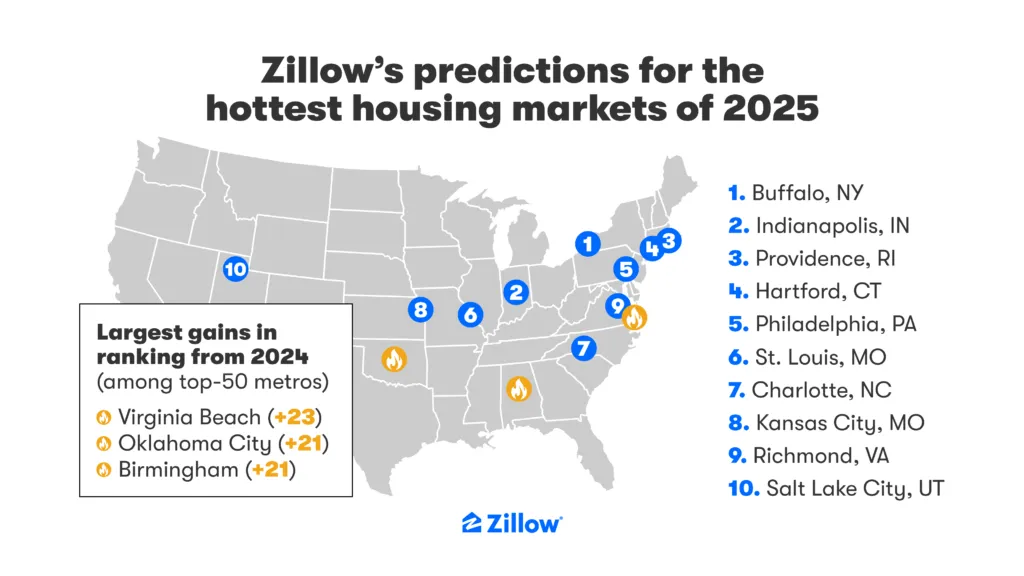
If you're trying to determine where the real estate stock will be in 2025, look no further! According to Zillow analysis, the The hottest real estate markets for 2025 will be largely concentrated in the Northeast and Midwest, with Buffalo, New York topping the list again. These markets stand out for their combination of relative affordability, job growth, and a rapid pace of sales. In some cases, homes sell within a week, far exceeding the national average. Let's take a look at why these particular areas are poised to continue getting stronger. Top 10 Real Estate Markets by 2025: Zillow Predictions Why these markets are heating up When Zillow When crunching the numbers for their 2025 listing, they looked at more than just prices. The analysis focused on several key factors: Home value growth: This measures how much home values ​​are expected to increase. It is not always about taking the biggest leap, but about sustainable and constant growth. Projected change in owner-occupied households: This gives an idea of ​​future demand. More homes means more people looking for homes. Job growth versus new construction: A vibrant job market attracts new residents, but if not enough new homes are built, competition will increase, which can put upward pressure on home prices. Sales Speed: This looks at how quickly homes go from listed to pending sale. Quick sales are a sign of high demand. These factors, working in combination, reveal areas that are not only desirable now, but are predicted to maintain that momentum. The fact that only four cities from last year's list have remained shows a clear shift in market dynamics, further highlighting the importance of staying on top of these changes. The Top 10: a closer look Here are the 10 metro areas that Zillow has identified as the hottest by 2025: Range Metropolitan area Expected growth in home values ​​(2025) Typical value of a home (2025) Days until pending sale 1 Buffalo, New York 2.8% $267,878 12 days 2 Indianapolis, Indiana N/A $285,086 14 days 3 Providence, Rhode Island 3.7% N/A 12 days 4 Hartford, Connecticut, USA 4.2% $378,693 7 days 5 Philadelphia, Pennsylvania 2.6% N/A 11 days 6 St. Louis, Missouri 1.9% $254,847 8 days 7 Charlotte, North Carolina 3.2% $389,383 20 days 8 Kansas City, Missouri, USA 2.7% $307,334 9 days 9 Richmond, Virginia, USA 2.9% N/A 9 days 10 Salt Lake City, Utah, USA 23% $555,858 19 days Source: Zillow Let's review each city: 1. Buffalo, New York: Buffalo He is a champion repeater. The city's resilience, its unique blend of urban living and natural wonders like nearby Niagara Falls, and its relatively affordable housing continue to attract people. While growth is expected to slow slightly, the market remains competitive and homes are coming off the market. in just 12 days. Buffalo has always intrigued me. It has a very attractive 'comeback' feel to it, like it's really discovering things as a city and people want to be a part of that. 2. Indianapolis, IN: To be honest, I'm surprised to see this area on the list. But a coastal city, with its central location and a strong job market, particularly in the pharmaceutical sector with the presence of Eli Lilly, are likely the factors contributing to the city's growing popularity. Houses in Indianapolis move pretty fast, on average two weeks pending sale. While this is tilted slightly towards the buyers side, it is still a very fast pace. 3. Providence, Rhode Island: This city wonderfully combines history, art and education. It seems that the charm of its waterfront parks and the presence of Brown University and the Rhode Island School of Design are a big draw. 12 days That's all it takes for homes here to sell. 4. Hartford, Connecticut: City home values ​​are forecast to have the biggest growth on this list, in 4.2%although this is actually slower than last year's whopping 7.4% hop. With homes leaving the market at an average of only 7 daysPotential buyers should have their financing arranged in advance. I think the fact that it is close to other major cities in the region is also a factor. 5. Philadelphia, Pennsylvania: Philadelphia is a city with a deep historic and walkable presence. While the market is not as hot as last year, a 2.6% growth forecast and homes pending entry 11 days It means buyers still need to be prepared to act quickly. Philadelphia is a great place; I can totally understand why people want to live there. 6. St. Louis, Missouri: Affordability remains a key draw for St. Louis, especially for first-time buyers. With the lowest typical home value listed in $254,847is 1.9% The growth forecast is a modest jump, while homes are selling at about 8 days. It also seems like a great city to live in. 7. Charlotte, North Carolina: Charlotte, known as the “Queen City,” has a lot going for it: warm weather, plenty of sports teams, and a growing population. A projected 3.2% The increase in home values ​​combined with a 20-day sales average shows a fairly competitive market. Personally, I always thought Charlotte was an underrated city. 8. Kansas City, Missouri: A place of culture, known for its barbecue, musical history and impressive fountains, Kansas City is projected to see a 2.7% increase in home value and an average sales time of only 9 days. Kansas City's historic atmosphere, combined with its affordability, can definitely make it a hotspot for many people. 9. Richmond, Virginia: Virginia's historic capital offers a rich social, dining and arts scene. Buyers will need to be alert as homes sell quickly in an average of 9 days. The city market is expected to grow 2.9%. I think Richmond has a certain charm that can be very attractive. 10. Salt Lake City, Utah: Salt Lake City made the list because of its proximity to outdoor activities, especially skiing. With an average home value of $555,858It is the most expensive market on the list. 19 days is the

Top 10 Real Estate Markets by 2025: Zillow Predictions Read More »

Zillow39s Hottest Real Estate Markets in 2025 Latest Predictions.webp Zillow's Hottest Real Estate Markets in 2025: Latest Predictions

Zillow's Hottest Real Estate Markets in 2025: Latest Predictions

Well, let’s get right to the point: If you’re wondering where the real estate stock will be in 2025, Zillow’s Hottest Real Estate Markets for 2025 are directed by Buffalo, New York as the first predicted position. Yes, Buffalo is once again predicted to be the most competitive market for buyers across the country. But don’t stop there! The real estate landscape is much more nuanced than that of a single city, so let’s dive in and explore what these trends really mean for you. Why Buffalo again? It’s not every day you see a city take first place in the real estate rankings two years in a row, but that’s exactly what Buffalo is doing. I know, you might be thinking, “Buffalo? Really?” But trust me, the data doesn’t lie. What’s pushing Buffalo to the top? A potent combination of limited supply and a good number of new jobs entering the area, which creates a recipe for high competition. Builders are struggling to keep up with the influx of new residents, leaving housing in short supply. And, from what I’ve heard from colleagues, buyer competition never cooled off last year. Zillow’s Hottest Real Estate Markets in 2025: Latest Predictions Beyond Buffalo, there are other cities poised for significant growth, so if Buffalo isn’t your thing, there are plenty of options. Let’s take a look at Zillow’s The 10 hottest real estate markets by 2025, according to their latest forecast: Buffalo, New York Indianapolis, Indiana Providence, Rhode Island Hartford, Connecticut, USA Philadelphia, Pennsylvania St. Louis, Missouri Charlotte, North Carolina Kansas City, Missouri, USA Richmond, Virginia, USA Salt Lake City, Utah, USA Source: Zillow What catches my attention about this list is the geographical diversity. It has strong contenders from the Northeast, the Midwest, and even a presence from the South and West. It tells us that this trend is not just localized but a broader change, reflecting different dynamics across the country. What is driving these markets? So what’s the secret ingredient behind these promising cities? Well, it’s more than just one ingredient: Affordability: Many of these markets offer a relatively lower cost of living compared to major metropolitan centers such as New York City or Boston. It’s no surprise that cities like Providence and Hartford, quite close to those megacities, are seeing a surge in popularity. It seems that people are looking for a balance between career opportunities and manageable living expenses. Job growth: A booming job market is a sure sign of a strong housing market. Places like Buffalo, which has seen a substantial increase in employment opportunities compared to new housing permits, will naturally be hot spots. It is a classic case of demand exceeds supplywhich can raise prices and create competition among buyers. Demography: Both baby boomers and millennials are active players in the housing space, and by 2025, 42 of the 50 largest markets are expected to experience an increase in homeownership. Austin, Orlando and Jacksonville are especially expected to experience a major boom in the sales market. However, places like Birmingham, Hartford and Oklahoma City are expected to see a drop in the number of homeowners. This demographic shift suggests that there are many potential buyers eager to enter the real estate market. Home value growth While many markets are expected to have positive appreciation, some have very slow growth. Indianapolis, for example, is expected to see its home appreciation grow from 2.8% last year to 3.4% in 2025. In other cities like Buffalo, appreciation is expected to fall from 5.8% in 2024 to 2.8% in 2025. It’s worth noting that even the best-performing markets can look tame in terms of numbers, compared to the huge price growth we saw in 2021 and 2022. The biggest jumpers and droppers It’s not just about the top 10; it’s about movement within the ranks. Virginia Beach made the biggest jump, rising 23 spots from last year’s list. This jump is mainly due to a significant increase in employment growth that far exceeds the number of new homes being built. On the other hand, Memphis experienced the biggest drop, falling 30 points as new home construction has outpaced low job growth in the area. This tells a very simple but important story: a healthy housing market needs to have a balanced mix of job opportunities and housing supply. Cooling markets to take into account While many areas are warming up, there are some markets that are expected to cool down. cities like New Orleans, San Francisco, San Jose, Portland and Austin They are expected to have weak demographic and labor market pressures, stagnant or falling home values, and are expected to see slow growth. In fact, even places like New Orleans are expected to experience a decline in home values! It just goes to show that not all markets follow the same trend and that there is much more to this equation. What this means to you Whether you are an experienced investor or a first-time home buyer, this information is important. Here’s what you should keep in mind: For buyers: If you’re targeting one of these hot markets, prepare for competition. You may want to get pre-approved for a loan and consider working with an experienced agent who understands the dynamics of the local market. Be prepared for a potentially expedited process and be prepared to act quickly. For sellers: If you own a property in one of these high-demand areas, it’s probably a good time to sell it. However, don’t be too greedy and work with a good real estate agent who can help you value your property correctly and get you the right offers. For investors: Understanding these trends can guide your investment decisions. These markets are worth exploring. Personally, I think it’s likely that places like Buffalo, despite the slowing rate of appreciation, will still offer promising returns, especially if they are able to continue retaining and attracting talent and expanding their labor markets. The numbers behind the predictions Zillow uses a

Zillow's Hottest Real Estate Markets in 2025: Latest Predictions Read More »