

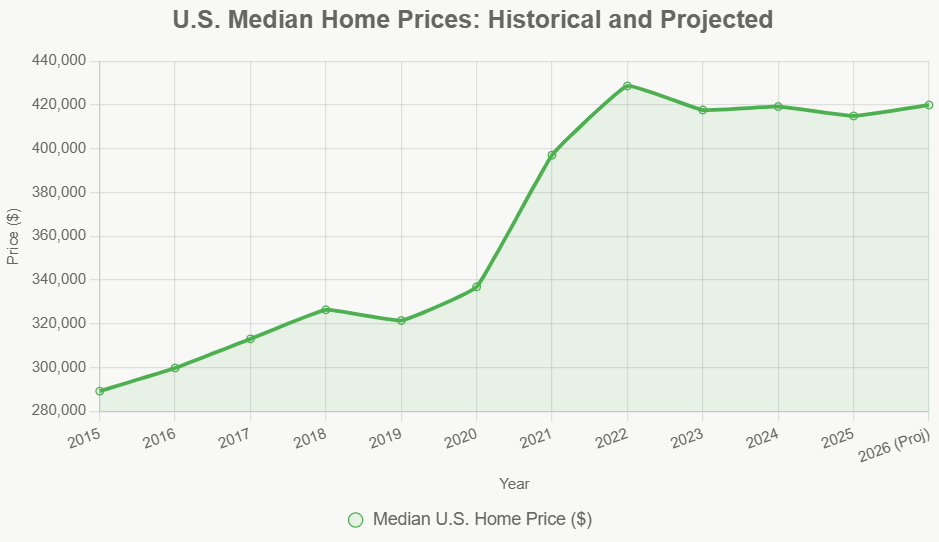
The US housing market in 2026 isn’t set for a dramatic crash or an explosive boom. Instead, expect a period of modest growth and gradual rebalancing. Picture it less like a roller coaster and more like a steady climb, with a few bumps along the way. This is welcome news for those who’ve been waiting on the sidelines, uncertain about the market’s direction.
Real estate market predictions for 2026: no bust, no boom, just rebalancing
As we approach the year 2026, I’ve been looking at all the reports and talking to people who live and breathe real estate. It seems that the feverish rhythm of a few years ago has definitely calmed down. We’re not seeing the crazy bidding wars or houses going off the market in one day like we saw during the pandemic. On the other hand, fears of a massive price drop also seem exaggerated.
Here’s my opinion, based on what the experts say and what I’ve seen myself: the market is returning to a more normal pace. Prices will likely slowly rise, and more homes will be sold, but it won’t be a story of explosive profits or devastating losses.
What’s causing this predictable path?
What makes me confident that things will stay relatively stable is a mix of economic factors, housing availability, and, of course, the cost of borrowing money.
- Interest Rates: Still a Big Problem, But Improving
- The days of snagging an almost free mortgage are long gone, and it’s unlikely they’ll return anytime soon. Experts predict the average 30-year fixed mortgage rate will hover around 6.3% in 2026. That’s a bit lower than before, which is worth noting, but still much higher than the rock-bottom rates from a few years back. This steeper borrowing cost is a big reason we won’t see a housing boom—it makes buying a home pricier and slows price growth. I remember when mortgages felt like free money. Now, the jump in monthly payments is something everyone has to consider, and it can quickly become a major hurdle for many buyers.
- More houses are hitting the market, though it’s not exactly a flood. One of the biggest challenges for buyers in recent years has been the limited selection, but that’s starting to change. For 2026, the supply of homes for sale is expected to rise to about 4.6 months, a healthier figure compared to the 3 or 4 months we’ve seen lately. In other words, if no new homes were added, it would take roughly 4.6 months to sell what’s currently available. With more options out there, sellers may need to be a bit more patient and open to negotiating. This boost in supply is a key reason why sales could climb to around 4.2 million homes.
- The economy: The overall health of the economy plays a big role. By 2026, we expect steady growth, with the Gross Domestic Product (GDP) projected to rise between 2% and 2.25%. The unemployment rate should hover around 4.7%, which isn’t bad at all. Inflation, though still something to watch, is likely to settle between 2.3% and 3%. Altogether, these numbers suggest an economy that’s neither overheating nor collapsing, creating a stable backdrop for the housing market without sudden price spikes or crashes.
A look at the numbers: what the experts say
To give you a clearer picture, let’s look at some of the key predictions.
| Factor | Current (estimate end of 2025) | Projected (2026) | Key takeaway |
|---|---|---|---|
| Housing price change | Slight drop/plateau | +1% to +2.2% | Modest and controlled growth, not a boom. |
| Home sales volume | ~4.08 million | 4.13-4.26 million | Gradual increase, but still below the pre-pandemic level. |
| 30-year mortgage rate | ~6.6% – 6.7% | ~6.3% | It remains high, which affects affordability. |
| Inventory (Months) | 3-4 months | ~4.6 months | Improved offer, relieving buyer pressure. |
| GDP growth | – | 2% – 2.25% | Constant economic expansion. |
| Unemployment rate | – | ~4.7% | Healthy labor market. |
| Inflation | – | 2.3% – 3% | Cooling down, but still a factor. |
The numbers clearly tell a story of moderation. We’re not heading into a steep price drop like the 2006-2008 crash, nor are we seeing the double-digit percentage jumps of 2020-2022. 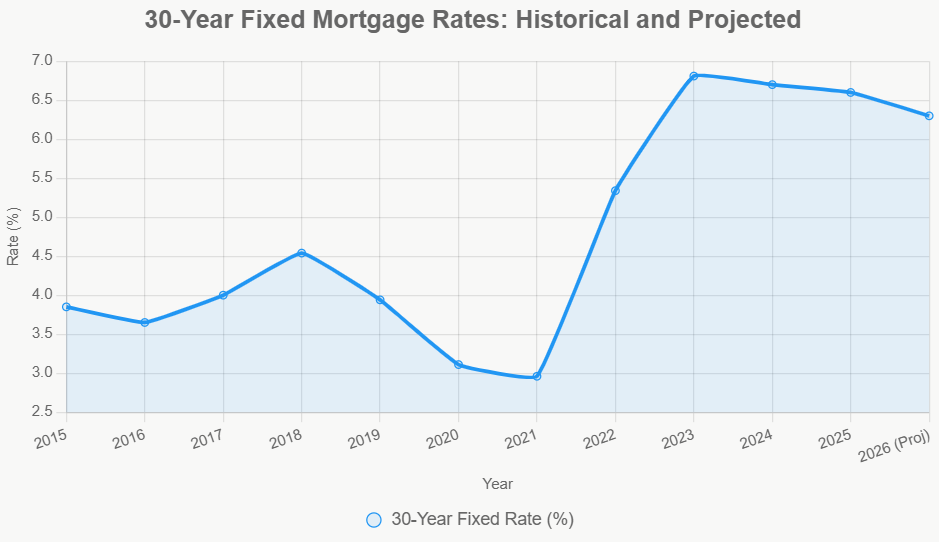
Regional differences: it is not the same everywhere!
One key thing to remember is that the American housing market isn’t one big, uniform entity—location plays a huge role.
Cooling in the Sun Belt: States like Florida and Texas, which experienced massive growth, could start to cool off a bit. Factors like rising insurance costs (especially in Florida) and potential overbuilding in some areas might lead to slightly lower prices or slower growth.
Rust Belt Rising (Slowly): Meanwhile, Rust Belt cities, such as Cleveland and parts of the Midwest, may see steadier, more reliable gains. Why? Because they’re more affordable, and more people are moving there in search of jobs and a lower cost of living.
Let’s put this into a table so it’s super clear:
| Region/Metro | Projected price change (2026) | Key driver |
|---|---|---|
| Cleveland, Ohio, USA | +3% to +4% | Affordability, job stability |
| Chicago, Illinois | +2.5% | Shortage of supply and urban reactivation |
| Miami, Florida | -2% to -3% | Insurance increases, hurricane risks |
| Austin, Texas, USA | -1.5% | Over construction, office returns |
| New York Suburbs | +2% | Hybrid labor migration |
| Los Angeles, California | Department | High costs, shifts within the metro |
This really proves you can’t just rely on national numbers and expect them to reflect our country’s situation. The local economy, job market, and even factors like weather and insurance costs make a big difference.
What about potential crashes or booms?
While the overall picture is one of stability, it is always wise to consider the “what ifs.”
- If an accident were to happen (though it probably wouldn’t matter much), it seems pretty unlikely that we’d see a nationwide crash with prices dropping by 10% to 20%. Protections are much stronger now than in 2008. For instance, most homeowners have built up substantial equity, giving them a financial cushion. Plus, the limited supply of homes helps keep prices from falling too far. Still, there are a few factors that could cause issues:
- If the economy suddenly tanks and a lot of people lose their jobs, especially in high-paying industries, housing demand could drop fast. Unexpected economic shocks, like new trade disputes driving up inflation and pushing the Federal Reserve to hike interest rates even more, could also deal a heavy blow to the market. And while more localized, major hurricanes or severe weather causing widespread damage and skyrocketing insurance costs could force some homeowners to sell at a loss.
- A boom—meaning prices rising by 5% or more nationwide—seems unlikely by 2026, even if it were to happen smoothly. The main challenge is affordability. Despite slightly lower interest rates, buying a home remains a major financial stretch for many, especially younger generations. So, what might give the market an extra push?
- Millennials and Generation Z are entering their prime home-buying years, driving up demand in the housing market. With more houses being built, builders who offer incentives like mortgage rate assistance could speed up construction and bring even more homes to market. Meanwhile, investors—both individuals and companies—continue buying properties to rent, helping keep prices supported.
The Big Picture: A Reset, not a Radical Change
To summarize, I don’t see a housing market crash in 2026, nor a wild boom. What I do foresee is a reboot. The market is moving towards a more balanced and sustainable path.
Affordability is slowly improving, more housing is available and the economy is expected to do well. There will always be unexpected events, so it is wise to stay informed. But for now, the evidence points to a housing market that is recovering and advancing at a steady pace.
For anyone who’s been waiting to buy, patience could be rewarded with more options and stable prices. For homeowners, their investment is likely to continue to hold its value and modest growth is expected. It’s a market that’s evolving, not exploding, and that’s fine.
