

There has been a lot of talk lately about how a government shutdown impacts the real estate market. You may be wondering: Is it causing everything to stop?
The short answer? No.
The real estate market does not stop. Keep moving. Homes are still being bought and sold, contracts are still being signed, and closings are still happening. The difference is that some parts of the process may slow down a bit, but in general, the market continues to function.
This is what usually happens
Every time the government shuts down, some federal agencies temporarily close or reduce operations. That can cause some hiccups in the real estate sector, especially when it comes to processing certain types of government loans and insurance requirements:
- “Applicants for FHA, VA or USDA loans, which account for about a quarter of all mortgage applications, may encounter significant processing delays due to agency payment suspensions.” – Selma Hepp, chief economist at cotality
- “According to recent estimates, More than 2,500 mortgage originations per business day are at risk of delays during a shutdown. . .”-Zillow
- Flood insurance approvals may also be suspended. The National Flood Insurance Program can be temporarily affectedwhich delays closures in flood-prone areas.
Even with those challenges and delays, most transactions still take place. Buyers keep buying, sellers keep selling, and agents keep helping people move forward.
The real estate market usually recovers quickly
And you can see that in this data. If you look at the most recent government shutdown that started in late 2018 and lasted 35 days, sales activity fell very slightly. during the closure but it recovered once the government reopened.
Data from National Association of Realtors (NAR) shows that existing home sales slowed for about two months and then quickly recovered as delayed closings made their way through the system when the government reopened (see graph below):
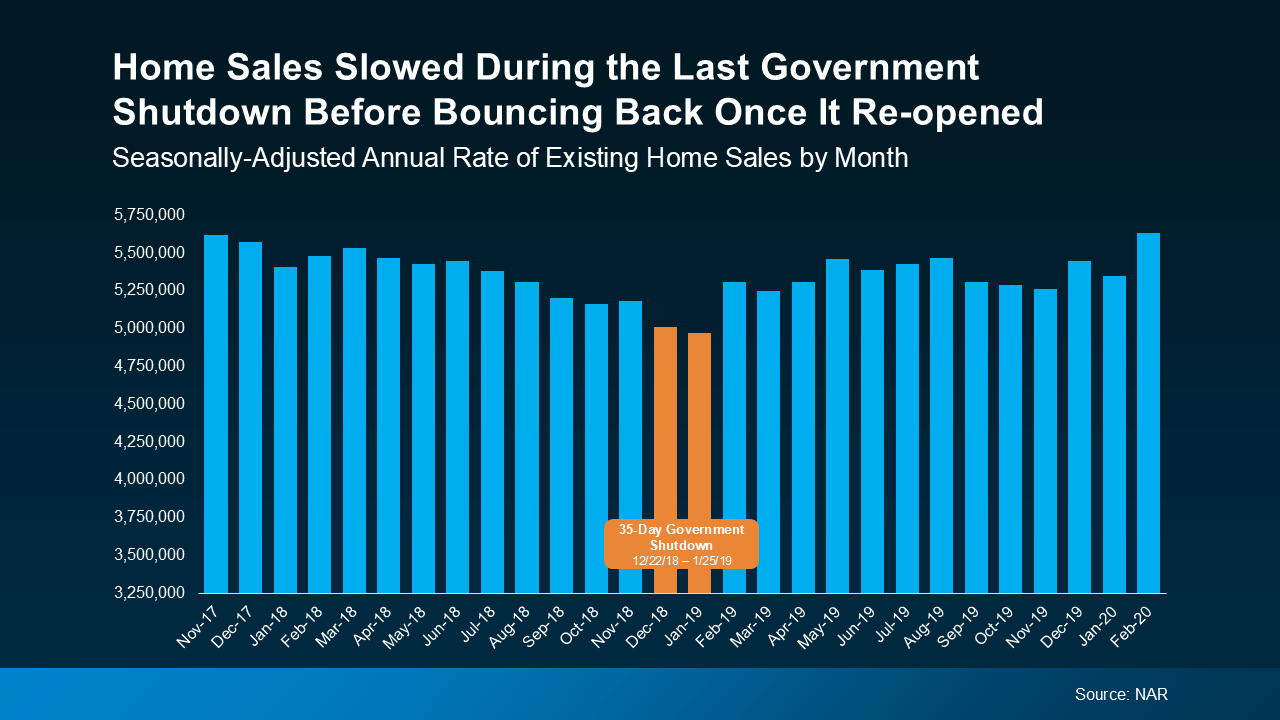 What’s important to note is that the slowdown seen in the orange bars on this chart was not simply due to seasonality in a typical housing market cycle. The steeper and shorter decline in this case lines up exactly with the 35-day government shutdown, and then sales rebounded as soon as it ended.
What this means to you
If you are in the middle of buying or selling a home, don’t panic. Most deals will continue to move forward, even if it takes a few more days. Jeff Ostrowski, real estate market analyst at bank rateexplains:
“If you expect to close in a week or a month, there could be some slight delay, but I think for most people, it will probably be more of a blip than a real killer.“
And if you’re just starting to think about buying or selling, this could work in your favor. Some buyers and sellers may become cautious and pause their plans during uncertain times like this, and that can open a brief window of opportunity.
When there are fewer people active in the market, well-prepared buyers may encounter less competition for homes and motivated sellers may be more willing to negotiate. These brief slowdowns often create a moment where you can do a movement that would be more difficult once activity picks up again.
A government shutdown may cause short-term delays for some buyers, but it doesn’t derail the housing market. The last time this happened, sales rebounded as soon as the government reopened.
If you’re not sure how this might affect your plans, or just want to understand what’s happening, connect.
